Sunday, 30 September 2012

THE WISDOM OF CROWDS


I was happy to have a second piece accepted for BT Life's a Pitch website this week, particularly because they (a) answer my emails, and (b) pay very well. 

The subject of the article was how the Anfield crowd could see through the poor results (the pitch was made before the victories at WBA and Norwich) and discern genuine signs of improvement under Brendan Rodgers. The impression that the Ulsterman is a man of great perceptiveness and cogency is being confirmed  by the manner of Liverpool's play and the results, not to mention some snippets from the slightly corny Fox documentary, Being: Liverpool. 

Overall, I thought the BT LAP sub editors did a decent job with the copy I submitted, although they did manage to excise two quite good gags (one comparing Gary Neville to Morrissey, the other describing Hodgson's 4-4-2) that I will keep up my sleeve for a future date. They also removed a phrase that sought out some rapprochement between the Liverpool and Manchester United supporters after the unseemly chanting at the end of last weekend's match. Where I talk of "the furstrations of the American owners to reinforce one of the strongest spines in Europe", I'd added, parenthetically, "in another life, reason enough to foment solidarity between the ordinary supporters at either end of the M56". Oh well. 

Read The Wisdom of the Anfield Crowd.


Friday, 21 September 2012

THAT LONDON'S FOOTBALL FANS

Before Chelsea's frankly pretty flukey Champions League win this May, it was well known that no team from London had ever won Big Cup. At first glance, such a fact appears decidedly strange, given the size of the city and the number of clubs...only that, perhaps, is the point: no other city the size of London has quite so many top-flight clubs. Anyway, the distribution of the city's variegated football fans is neatly shown by this map (a WIP).* The only club missing is, of course, Manchester United... 


* Thanks to Jake Goretzki for the source, not to mention the gag that follows, although I would also have made it. Open goal, eh? 


THE AUTUMN OF STEVEN GERRARD


They say the darkest hour comes before the dawn, although whether or not that includes false dawns – of which there have been a few at Anfield in recent times – isn’t entirely clear. It has been confusing not only for Liverpool’s battered and bruised supporters to ascertain whether the pale sun above them was rising or setting, but also for their talisman, Steven Gerrard.

He has seen the promise of Benítez’s side allowed to wilt on the vine and the early Dalglish bump run aground on a catastrophic shopping spree. Now, Liverpool’s failure to secure another striker in the summer transfer window leaves him further away than ever before from capturing another Premier League title.  

Brendan Rodgers had arrived on Merseyside with the promise of tiki-taka (not easy to say in a Scouse accent), something that even the most wildly optimistic of supporters realized would take time to deliver. Yet the almost face-spiting parsimony and inactivity of the transfer window saw the skies darken again on Merseyside, and moved John W. Henry to send the supporters a ‘Letter from America’: “We should have held you / We should have told you / But you know our sense of timing / We always wait too long.” 

This new upswell of doom and gloom crested the Sunday before last at home to Arsenal, when Luis Suárez – attempting a too-cute finish to a chance that he needed to put his foot through – spooned a shot over the bar and into the groans of the Kop. Sky Sports’ summariser Alan Smith – no stranger to spoiling the mood at Anfield as an Arsenal player down the years – and co-commentator Rob Hawthorne instinctively (and appropriately) adopted the sort of solemn, hushed tone that one hears at funerals. There was no scope for any other reaction: the Kop’s native stoicism prevented any self-pity or maudlin; realism foreclosed any voluble and explicit condemnation of the player, now Liverpool’s sole experienced centre forward.

The cameras cut briefly to Gerrard, the man who has spent the tail end of his career witnessing such disappointment. Heaven knows what was going through his Steven Gerrard’s mind at the time of Suárez’s miss, or 36 hours earlier when the window was shut and curtains closed on Rodgers’s squad reinforcements.

However, recognised or not, the forlorn skipper’s mood was undoubtedly the greatest cause for solemnity. After all, this was surely the moment (or the match, at least) when the long-cherished dream of a nineteenth top-flight title – or a first, depending on your point of view – was finally, irrevocably extinguished. No more sunrises.

Even the flintiest of footballing hearts ought to acknowledge the transcendent suffering in this. Perhaps out of respect, then, the camera refused to linger on Gerrard for a second time that afternoon – for he had already had one abject look beamed across the globe, having earlier been guilty of a careless, close-up eliciting misplaced pass that led to the first goal (although to fail to acknowledge the brilliance of Arsenal’s counter-attack would be a travesty).


Of course, the last time Stevie G struck up a swanky partnership with a world-class Spanish-speaking forward, he was in his pitch-bestriding physical prime – a phenomenally effective player whose strengths were rooted in athleticism, courage and responsibility (even if those same traits meant searching too hard and too often for the Hollywood pass) – while his ‘other half’ was a stunner. His fling with Fernando Torres was a glorious, passionate affair – a summer of countryside lovemaking and frolics across the Old Trafford turf – but now the England captain must cosy up to his new Uruguayan clinch without the vitality and soft skin of his youth and with the grooves on that brow deepened as the furrowing has grown more frequent.

Some may argue that it is still not too late for Gerrard at Liverpool, citing the fact that his performances at Euro 2012 – up until his front-row seat (or was it third?) for Andrea Pirlo’s regista masterclass – were widely praised.

Yet there is the lingering impression that Rodgers’ way – concerted pressing and ball possession, using the full acreage of the pitch to achieve that – implicitly endorsed in Henry’s open letter might signal Gerrard being eased toward the Anfield periphery (although the punditariat are already getting twitchy and stuck in about playing out from the back). To provide guile, the Ulsterman has brought in his trusty deep-lying midfield playmaker, Joe Allen, along with Nuri Sahin; to add thrust, there’s Fabio Borini, Oussama Assaidi and greenhorn Samed Yesil. In short, the component parts of Gerrard are gradually being outsourced, a squad makeover that inevitably invites us to ask: where does this leave Cap’n Stevie?

Slow revolutions are not ideal for the peace-of-mind of a 32-year-old for whom the competitive fires must continue to burn fiercely. He still no doubt wants to play like the best in kid in primary school, the one who scores 117 goals per season and is four inches taller than the others, but the body’s protests are always reluctantly accepted by the mind and this athlete-footballer doesn’t appear to have as straightforward a veterans’ niche as, say, Paul Scholes, six years his senior, at Manchester United. Like a favourite yet ageing dog who, happy to be off the leash, scampers after the first couple of throws with alacrity before succumbing to the complaints of his weary limbs, the veteran Gerrard must adapt, slow down, and stop chasing the ball all the time.

Even so, it is certainly not yet time for Liverpool to look into the dimming, waxy eyes of this favourite Koppite pooch and make the difficult decision of taking him on that journey to the vets for that injection. But tactical discipline and simplicity have never been his forte (which is why Benítez moved him forward for his halcyon years, away from the boiler room) and so the future remains unclear.

Either way, if the Arsenal game is the definitive onset of Gerrard’s autumn, physically and emotionally, then, as his nights draw in – even, perhaps, as a new dawn approaches for Liverpool – we do need some proper perspective on this final phase of his career, to take stock of his contribution to the game on these shores. And respect would be the correct tone. 


Has he been frequently overrated in the British media? Perhaps. A sower of chaos? Without doubt. But for better and for worse – both occasionally confusing the positioning of teammates, yet providing considerable final-third cut and thrust.

Yet beyond the partisans’ squabbles, the hype and the jibes, we should remember that Gerrard is that rare creature: a one-club man. And not a one-club man like Giggs and Scholes, Baresi and Maldini, Xavi and Puyol, with their trophy cabinets the size of swimming pools and thus scant incentive to think the grass could be greener anywhere else. No, here’s a one-club man for a team that, during his career, has rarely been truly competitive over the long course and which, perhaps increasingly burdened by its history, both glorious and tragic, has often struggled to punch its weight.

Here is a man who, while well remunerated for his work (although he would surely have been equally so at Real Madrid, Chelsea or a host of other suitors), has sacrificed opportunities for glory elsewhere for the love of his club and for the dream of making its fans’ dreams come true.

In this of all ages, supporters of all colours – even those along the East Lancs Road and across Stanley Park – ought to acknowledge and respect the old-fashioned virtues in that loyalty.


A version of this was published by ESPN. It’s fair to say the homoerotic passage didn’t go down very well…


Saturday, 1 September 2012

HARRY REDKNAPP ON THE RUNNERS AND RIDERS


RELEGATION CANDIDATES 
Aston Villa Top, top coach, Paul Lambert. They'll be fine. 
Fulham I think Martin's bought some fantastic players in. They'll be fine. 
Norwich It's going to be difficult, but I honestly think they'll be fine, I really do. 
QPR They've backed the manager, that's for sure. They'll be fine. 110%. 
Reading Yeah, no, I think Brian's got some real good players there, y'know, and Reading'll be fine.  
Southampton They'll have a right go. They'll be fine, for me. 
West Brom Steve Clarke's a good coach – top coach – and they'll be absolutely fine. 
West Ham Big Sam's bought well. I think they'll be fine. I can't see them matching the fifth-place finish I got there in 1999, but they look powerful, solid, and they'll be OK. 
Wigan They'll be fine. They'll be alright. Roberto Martinez? Absolutely fine. 

EUROPEAN CANDIDATES 
Arsenal Top four, for me. Nailed on. 
Chelsea Robby did ask me about the boy Hazard in the summer and I thought he was talking about Micky. Told him he'd retired 20 years ago. No, no, seriously, I told him I thought he'd be a triffic signing. He can pass it, he's got everything. I wouldn't be surprised if they won it, I really wouldn't. 
Everton What a job Moyesy's done. Incredible really. Year in, year out. Triffic manager. Top six, for sure. 
Liverpool Yeah, Brendan came and did a week with me at Tottenham. Bright lad, good learner. They'll sneak in for Champions League, no doubt about it. 
Man City I think they look strong. I can't see them not winning it, to be honest. 
Man United They've got goals in 'em. Van Persie and Kagawa, y'know, are top, top, top players. They'll win it for me. 
Newcastle Scouted well has Alan Pardew. Top six, without doubt, maybe even Champions League this time. 
Sunderland Yeah, he's got some good signings in has Martin. I like the look of the boy Johnson. They'll be top six, no question. 
Tottenham Had they not lost Luka, who's just been flying ever since I moved him in off the left, y'know, then I'd've said they should be favourites for the title to be honest with ya. But top three, top four, for sure. 

MID-TABLE KNIFE EDGE 
Stoke I can't see them being sucked in. They'll be fine. I even think Tone could squeeze 'em into Europe, I really do. Crouchy... No, top six. 
Swansea I like Laudrup. Tried to bring him to Bournemouth when I beat Man Utd in the FA Cup with 'em in '84, but he was happy at Juventus. But no, they'll kick on this year, for sure. It wouldn't surprise me at all if they get in the Europa League. 


Wednesday, 8 August 2012

HUDDLESTONE: LIBERO?


For an aspiring writer, the endless effort to find publication at places that actually pay hard currency is gruelling and soul-destroying in equal measure. Thus, it was pleasing to have a first pitch accepted over at BT Life’s a Pitch; even better that, five days later, it was the most popular piece on the site (assuming that wasn’t manually chosen). Its subject matter? Why Spurs should deploy Tom Huddlestone as a libero.

Now, popularity’s not necessarily a good thing with things like this. It could simply be the result of how off-beam the opinion piece was: a car crash has a certain fascination, after all. If you read the first comment, the suggestion is that I’d been “smoking crack”. Nevertheless, a few people sprung to its defence and, overall, it sparked a bit of debate, which, I guess, is what websites are after: traffic, innit. Triffic.

Anyway, irrespective or not of whether I was talking sh*te, it undoubtedly contains the best Stature of Liberty-related pun you’re going to have read on the whole Internet that day. Describing Big Tom as a potentially “statuesque libero,” I went on to say…well, have a look for yourself.


Friday, 27 July 2012

PRETTY VACANT: BECKHAM, LONDON 2012, AND THE 'FACIALITY MACHINE'


Attention seeking. At the start of an individual’s life, attention seeking is a manifestly qualitative matter: the desperate, instinctual search for the sort of loving care, protection and nurturing that is the difference between life and death. It is not a matter of being looked at, but being looked after. By the time we reach adulthood, this simple evolutionary mechanism has for most people become dormant – we have survived to fend for ourselves (in ordinary circumstances, at least, and there’s Dyno-Rod and Dominos for other occasions) – while the need for succour and validation that never fully leaves us is routinely sated by way of our ordinary social interactions, without any especial pursuit. In a certain category of human, however, attention seeking remains as involuntary and compulsive as it is for babies, albeit now for cultural rather than natural reasons. Hello, Celebrities – from A-list to Z-list and into the pool of wannabes whence crawl the narcissists and exhibitionists and drama queens, the extrovert sulkers and nonchalant fashionistas, all of whose histrionic bleating egos are so many great Ptolemaic suns at the centre of a private universe. Best not get too close.

Anyway, once an individual crosses the threshold of fame and becomes a Public Figure, an artfully manipulated persona (which derives from the Latin for ‘mask’), attention seeking becomes primarily quantitative – a measure of one’s social status. It’s about ratings, units shifted, bums on seats, hits – that is what advertisers want to know. No one particularly cares what type of audience-consumer it was – its qualities – since all of those specifics will be yesterday’s news before tomorrow arrives, bringing its fresh torrents of memory-sluicing of infotainment.

Of course, it is not exclusively the case that (the) celebrity seeks out the love of strangers to stanch some disorder or other. Sometimes – with a cynicism that itself might be considered pathological outside of neocon think-tanks – it is a simple exercise in cultivating fans by furnishing their often transparent, off-the-peg, no-frills fantasies. In any case, we all get along perfectly well – well, not perfectly well, but well enough – with our phobias and manias, our obsessions and occasional paranoia, our superstitions and other low-intensity quirks, be they medicalised or not.

They are even quite socially useful, at least from the standpoint of a protean capitalism – in the first instance, a matter of brute quantity, of course – that stalks every flickering sign of life, unslakable in its thirst for some new untapped well of profit (and boy, is compulsion profitable: gambling, porn, nicotine, guns…), some unkempt, exploratory, vagabond desires all ready to be corralled into the punctual delivery system of our industrialised, sanitised pleasures. 

Darryn Lyons: celebrity celebrity voyeur commissioner; attention seeker
extraordinaire; apotheosis of modern vacuity. Do we need to have a long hard
look at ourselves in the mirror (or are we doing quite enough of that already)?

Thus interlocking with slebs’ compulsive and/or cynical drive for ubiquity is a whole culture of attention seeking – what else is marketing? – a great white and its pilot fish of brazen liggers and dubious factotums who insinuate themselves between the bill and the board, the thickest spittle in town. A celebrity becomes an economy in itself, and their factitious gifts – their X-Factor – must be continually bestowed upon the populace, spattered across every medium. No event must be allowed to pass by unfructified by their celebrity juice, this ersatz postmodern aristocracy awaiting some new Jacobins to lop off their talking heads.

Anyway, the problem with all this is that the cloying ubiquity of these Nobodies (in French, personne) slowly comes to cloud the judgement of otherwise eminently sensible people – people of influence who ought to know better than to acquiesce in the whole sorry farrago; people who at some uncertain though definite point themselves cross a threshold beyond which they become detached from and oblivious to their initial distaste, sucking away complicitly on the cynicism of this Celebrity cult, a cynicism that is naturalised to the point at which even our cultural commentators can blithely declare “what’s the matter with it? It’s only a bit of fun,” and end up throwing their weight behind the runaway train…


* * *

…And so we arrive, via Bus Replacement Service, at London 2012: a bloody-kneed country, dragged through a hedge(-fund) backwards by the cocksure, coke-fuelled attention-seeking tyros of a deregulated financial sector, aghast (if not surprised) at the fawning accommodations of the government to bankers, appalled (if not surprised) by the MPs expenses scandal and the systemic phone-tapping of Andy-Liar & Murdoch – a country with a chance to redeem itself, to put on its Sunday best and pretend that everything’s OK, like some asphyxiating and neurotic petite bourgeois family traipsing across the country on Boxing Day in aching introspective silence to see the cousins, hovering about them all a tacit entente that no-one shall mention her unwanted pregnancy, his expulsion, that caution for shoplifting, the botched investment, but all will smile their way through denial and back to good health. London 2012: the nation’s shop window, they say (displaying no unauthorised rings, if you please), whereas the previous summer the city’s shop windows were merely the quickest route to the loot. London 2012: Viva Britannia!

Apparently, to do this, to put your face on, as a city, I mean, you need a famous face. Thus Beckham – who else? Danny Dyer, N-Dubz, Simon Cowell, Barbara Windsor and Jack Whitehall might have been in the running were it not a sporting event, while not even Lord Coe, as happy in the 1922 Committee as the 2012, would endorse the ludicrous berk, Boris Johnson. Beckham, meanwhile, is pretty much inoffensive; he was good at his profession (although a galáctico in marketability only); he is handsome (when he isn’t talking); and he is vapid enough to believe the ‘all is hunky-dory with Blighty’ propaganda. 


Before we scrutinize that particular face, we should note that what Gilles Deleuze and Félix Guattari call the “faciality-machine” [visagéité] has long been an important device for power formations seeking as efficient a means of subduing their populations as possible – from the days of Imperial coinage, when it was expedient to give the newly-subjected peoples a representation of the distant despot to whose divine body they would henceforth owe their life and pay tribute, through the statues and friezes of the modern dictators (Fidel Castro seems an exception to this, perhaps because Che was the face of the Revolution, as a glance at Cuba’s Ministry of the Interior building confirms) all the way to the election-attuned workings, the wall-to-wall posters of political PR machine within ‘late’ capitalism’s imagosphere. Images are perfect for efficient and swift subjugation. In a species who are highly-skilled face-readers before they can stand up, the image provides an instantaneous mobilisation of affect and is preferable to the somewhat passé and laborious narrative means of emitting signs to rouse people.

The face irradiates these wordless signs just as it embodies the People. It personalises the impersonal workings of power, be that the despotic apparatus over the horizon in the capital (deriving from the Latin for head, ‘caput’) or the abstract machine of private capital accumulation with which us ‘advanced’ and ‘civilized’ folk busy ourselves (or is it vice-versa?). The flash of an apparently beneficent smile that’s too bright to look at for long occludes tens of thousands of concrete, specific decisions about how social wealth is spent. (The question of Olympic ‘legacy’ – beyond the brief, vicarious afterglow enjoyed as others from this sea-battered hunk of rock win medals – is one for another time, but suffice to say Athens, eight years on, doesn’t look in the greatest of shape.)

Ordinarily a tabula rasa onto which the public, in its yen for uplift, projects its hopes and dreams, the faciality-machine is occasionally tasked with something more complex. When it is compelled to speak – an inherently risky undertaking from the point of view of the regime or institution (as much an immaterial rhizome of desires, beliefs, decisions and commands as a material entity) for which it provides anthropomorphised substantiality – there behind it will invariably lurk some on-message eminence grise adept both at smoothing out the pointy bits of language on which one is apt to choke as well as fashioning gaudy sentimental flourishes. So, while the ventriloquist spoonfeeds this platitudinous mulch of mots justes for the mouthpiece to regurgitate, for its part, the ‘logophagous’ face-machine must learn only to listen and talk at more or less the same time (an illusion of spontaneity amidst the near-simultaneity), a task in which even George W Bush managed to convince most of the time. 

Faciality-machine:  Juan Domingo Perón returns after 18 years in exile
(his image is flanked by Evita, left, and Isabel)

* * *

And so, Londoners, it is Becks: Reprazent. An East End boy made good, one of the most recognisable faces on the planet, a sporting beacon and clearly much more useful being wheeled between banks of flashbulbs and TV cameras as the face of the Olympics than he would be labouring in Team GB’s midfield. This is not a sneering pop at Becks per se, just an enquiry as to whether he’s, yerknarr, the man for the job, whether he ought to be the Face of the Games. David London. You want smouldering? Fine; call Becks. Pouting, you say? I have the very man. Viciously whipped-in free-kicks and corners you’re after? Why, there’s only one man for the job: David Beck– …er, Ryan Giggs. You know what I mean.

Charged with rallying the good will of a public drenched in the Establishment’s piss and shit, Beckham must be our Nelson Mandela, our Pelé, our Gandhi, our Eva Perón (for whose emaciated, cancer-ravaged body was fabricated, in June 1952, a wire and plaster support which was then wrapped in fur coat so that, weeks before her death, she could stand in the back of a car and wave at the masses attending her husband’s second inauguration, “a sacred icon carried aloft on a pole, a thing of inert sanctity”: the face of the regime). Whether Becks has an earpiece in or has been scripted is hard to determine. But speak he must. 


Having to say something is much less taxing than having something to say, having to have something to say, yet still presents its obvious pitfalls. So, to eliminate the possibility of faux pas and/or allow him to pick up the whispered words of some LOCOG worrier, His Royal Hairness, the Duke of Beckhamshire has duly slowed down his speech to the treacle rhythms of a Californian stoner.

Prompted by Sky Sports News earlier this week to transmute the Tour de France triumph of Bradley Wiggins into a harbinger of Team GB glory, our bunraku looked out over the Olympic Park and drawled:
My message to Bradley is: ‘Congratulations, you’ve made everyone proud. I’m sure you’ve made yourself and your family proud. But the whole country is behind you – was behind you – and, aah, incredibly, aah, y’know, incredibly proud of everything that you’ve achieved’. For any athlete to perform at their highest level, aaahm, is amazing. For someone like Bradley to perform the way he’s performed and, aaahm, to make people proud like he’s done, aaahm, y’know, makes the whole country proud and it kinda sets us up for an amazing occasion that’s coming up. 
When the fireworks have gone and the Olympians themselves have encased their medals on mantelpieces, when they eyes of the world (at least, those not in sweat shops, civil wars, concentration camps, subsistence farming, or otherwise engaged) have turned away, the city will rumble on as before, providing opportunities, imposing opportunism. Should there be any perturbation of this rigorous stratification of the city’s human material and the fatigue-clad State-protectors (and G4S deputies) will jump quick-smart to the defence of an elite whose relationship to them – whose gratitude for their blind loyalty – extends principally to the diary-disturbing possibility of having to be (seen) at their funeral.

Olympics? Fine, you enjoy them. We all have our opiates. But don’t tell me all is well here just because some cyclist from the Isle of Man finishes a race before someone from across the water – some other water. I am no longer prepared to put on a ‘brave’ face about it all. 


* This text was first published before Danny Boyle's magnificent, universally hailed opening ceremony, which, while containing enough of the familiar to placate the traditionalists and their view of what Britain is, or stands for (image), was also irrepressibly optimistic, forward-looking and young at heart, from the music to the choice of seven young athletes to light the stunning cauldron. Nevertheless, this does not vitiate the basic proposition of this piece: that the merits of Beckham as a face of the games, much less a spokesperson or ambassador, are simply a quantitative matter, concerning how widely recognizable he is rather than any particular qualities he brings to this role. As such, he is the acceptable face of vacuity.  


Tuesday, 3 July 2012

TOP 10 NATIONAL TEAM BADGES

So, after the Top 10 Club Badges must come those of national teams. Again, these have been evaluated and selected chosen using a methodology as secretive as the recipe for Lea and Perrins’ Worcestershire Sauce (and with an equally precise apportioning of the relative value of the various secretive criteria) and involving various specialists and institutionally recognised expertises and, y’know, whatnot. So, it’s all very scientific.

Furthermore, the judges are aware that these designs are not fixed but variable – and not just historically, but also according to use: one crest for the strip, another for the stationery… They weren’t bothered.


10: SAUDI ARABIA
A wholly meritocratic and forward-thinking selection (ironically, you might say) based on native design talents that are just crying out to be extended to women’s clothing. And men’s. Anyway, what’s not to like here? All green (like their flag); a striking, universal icon in the palm tree; interesting script that’s both bi-lingual and fully anti-clockwise; crossed swords that say ‘don’t fuck with us or we’ll set Saeed al-Owairan on you’; the look of a luxury brand (not beer). Yeah?


09: BRAZIL
OK, I – by which I mean the panel – admit that there might be ‘seepage’ here from the all-round cool reputation of the nation’s futebol, its panoply of languid stylists and the sort of commitment to attack you might see from Chris Gayle in a T20 superover, while their glorious history, present in the five stars (the fabled ‘penta’), might also have influenced the choice. But it does look good. And that is what matters. When it comes to everything.


08: GUAM
Having taken 35 years to beat another FIFA member, they are not, to be fair, a footballing powerhouse, but if they were giving out awards for the elegance of one’s logo then wee Guam would be mixing it with the likes of Spain, Italy, Argentina and Netherlands – in fact, if it were just on the badge, they’d be better! Again, we’re swayed by the palm tree motif, but there’s also something ineffably stylish about this, despite its inclusion of a ball (usually a no-no) and overall air of Cypriot plumber’s business card. Sometimes, it just ain’t logical…


07: CÔTE D’IVOIRE
I don’t get why we have to call them Côte D’Ivoire, rather than the English ‘Ivory Coast’. I mean, we use the English for France, don’t we? Also, given the dubious nature of this trade in elephant parts, why are we still calling them – they still calling themselves – by such a reprehensibly literal name? Is Ghana called Slave Coast, or ‘Côte D’Esclaves’ (notwithstanding the fact that it’s not a francophone country, which makes it odd that Desailly wound up over there…)? No, it isn’t. It is like Spain calling itself ‘Bullfighting’. Anyway, yeah, they’re known as the Elephants (not sure how the elephants feel about that), and they’ve thus got some elephants on the quite funky badge, although the trunk disappointingly stops with the initial letter ‘C’.


06: GERMANY
Maybe not the greatest Eagle – and if it were down to the non-naturalistic depiction of birds of prey (as was the case with the clubs), then Poland, the previous version, would have had a great shout – but the talons are undeniably excellent, the symmetry is as you’d expect, the minimalist reference to the national colours is chic and confident, and there’s absolutely no indication whatsoever that they are ready to crystallize a suicide State pursuing a delirious expansion-unto-death in order to rescue their economy (political and libidinal) from the low-intensity tedium of European austerity, setting history ablaze. None. Although, that tongue is fairly aggressive. And those talons…   


05: DENMARK
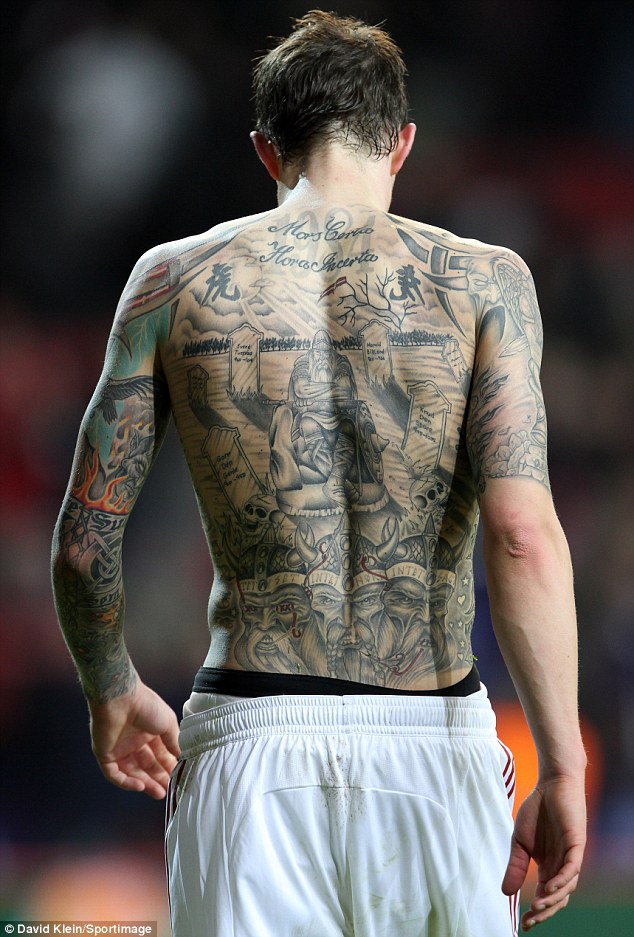
Now, I don’t know a huge amount about Denmark, but I realize that they’re fond of a tattoo (see Agger, Daniel) and their footy badge might lend itself to such a use since it has what design expert Jag Pfeffer called a “runey, Celticy, Dungeons-and-Dragonsy feel to it”. It does. It looks like the sort of stamp you get on the back of your hand at discos. Or a coin, perhaps. “The design flourishes and lightly seriffed twin fonts complement the concentric circular form,” continued Pfeffer. It never looked better than on the classic 1986 Hummel strip.


04: NORTHERN IRELAND
“Norn Iron”, they call ‘em, and this badge – a Celtic cross – certainly looks as though it would rust if left in a pool of water, alright. It also looks heavy, as though it would do serious damage if it was very hot and shoved hard in your face. A brand, no less, and isn’t that what all design is after? Nice and understated with the shamrocks, too.


03: ISRAEL 
Disclosure: there weren’t too many people from President Ahmadinejad’s cabinet in my panel of design experts, but this is still no sympathy vote. For the same reason (i.e. national symbol on flag, incorporated) that Canada – and I’m taking a bit of a punt here – might end up taking the gold, so Israel has to sneak in for bronze. OK, the design isn’t mind-blowing to look at – normally fairly important in competitions judging non-functional design – but it is ingenious, and sometimes you have to applaud ingenuity. Oh, Hebraic script also looks funky.


02: KAZAKHSTAN 
The break-up of the USSR and the ambition of one of its members in 2002 has given European footballers a taste of the sort of intercontinental midweek commutes routinely undertaken by the rest of the world’s elite (and thus almost exclusively European-based) footballers. The trip to Boltok the Rapist’s homeland is more than a 6-hour jaunt from the Atlantic nations (the Western Kazakh fringes are closer to Vienna than Almaty, the capital), so the very least you would expect when you get there is a decent logo on their kit. And they do not disappoint. Combining the failsafe design element of Cyrillic script (in elegant font, too) with impressionistic animal (the very popular eagle, here soaring), a sun (a.k.a. ‘bringer of life’) and a football bearing the national flag’s hoist side’s Baroque pattern (koshkar-muiz: ‘the horns of the ram’). All in all, this design manages to combine detail while stopping short of overly intricate. The Kazakhs have a crest that puts to shame those of all their fellow Asian former Soviet republics.


01: CANADA 
So, you’re from a country that has a maple leaf as its national symbol – a national symbol that sits centre stage on its flag (unlike our rose, or their thistle, or their fleur-de-lys) – and you want a logo for your football team, what are you going to do? You are going to keep it monochromatic and maybe select a font that flirts with a gauche futurism that’s not appropriate for your country, but that’s OK because it sort of echoes the shape of the leaves. And it is the best in the world (although this could have something to do with my Mexico 86 Panini; or, even more mysteriously, if the other list is anything to go by, there could be a pattern based on colour and horticultural genera). On that, the panel were unanimous.


AND THREE NEAR MISSES…

New Zealand – the fern symbol is awesome, but the judges felt it wasn’t quite specific enough to football.

Scotland – like Wales and England, there’s an ordinarily quite off-putting heraldic creature on the Scotland crest, but the combination of colours and the thistle motif almost carried the Tartan Army to the Top 10.

Korea – based on the Luxury Perishable Good/Designer Beer Label Theory.